
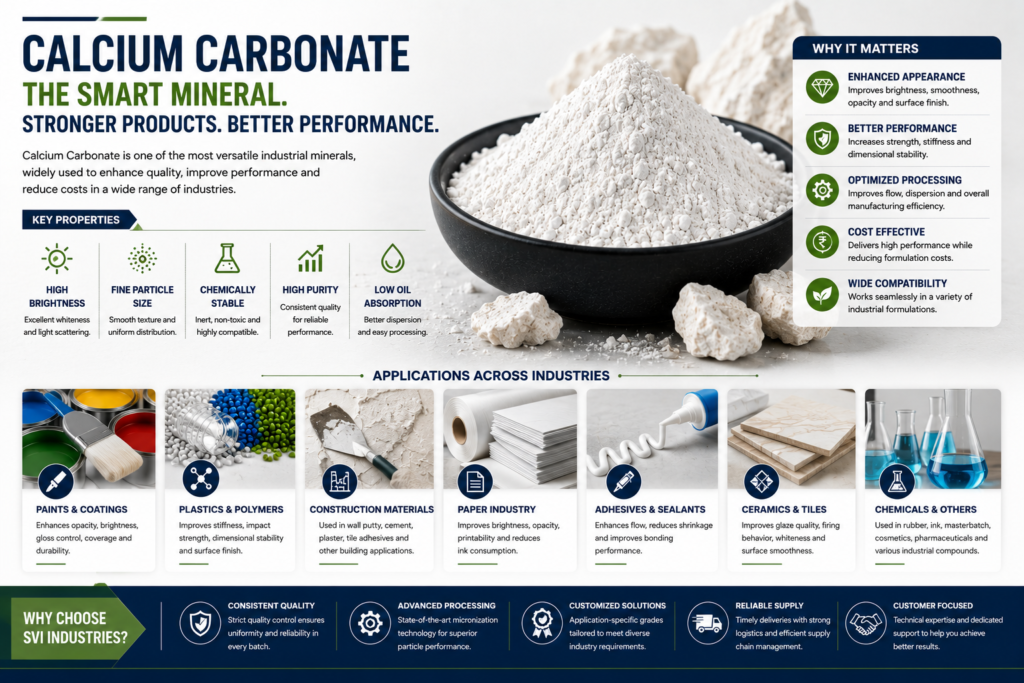
In today’s industrial landscape, manufacturers require raw materials that deliver consistency, durability, performance, and cost efficiency. One of the most widely used and highly versatile industrial minerals fulfilling these demands is Calcium Carbonate.
From paints and plastics to construction materials, paper, adhesives, and ceramics, calcium carbonate powder has become an essential ingredient in modern manufacturing. Its ability to improve surface finish, mechanical strength, opacity, processing behavior, and formulation stability makes it one of the most valuable functional minerals used across industries worldwide.
With advancements in micronization technology and mineral processing, high purity calcium carbonate is no longer considered just a filler material. It is now a performance enhancing industrial mineral that directly impacts product quality and manufacturing efficiency.
What Is Calcium Carbonate?
Calcium carbonate is a naturally occurring mineral commonly derived from limestone, marble, and chalk deposits. Its chemical formula is:
CaCO3
It is widely valued for its:
• High brightness and whiteness
• Excellent chemical purity
• Fine particle size distribution
• Smooth texture
• Low oil absorption
• Cost effectiveness
• Chemical stability
After advanced grinding and micronization, calcium carbonate powder becomes suitable for a wide range of industrial formulations requiring precision, consistency, and high performance.
Why Calcium Carbonate Is Important in Industrial Applications
The industrial demand for micronized calcium carbonate continues to grow because of its multifunctional properties. It helps manufacturers improve physical performance while optimizing production costs.
Surface Enhancement and Smoothness
Micronized calcium carbonate improves surface finish by filling microscopic voids and irregularities. This creates smoother and more uniform surfaces in paints, plastics, coatings, and construction materials.
Improved Brightness and Opacity
Its high whiteness and light scattering properties enhance brightness and opacity in decorative products. Manufacturers often use calcium carbonate to partially reduce expensive pigments like Titanium Dioxide while maintaining visual quality.
Better Mechanical Strength
In polymer and construction formulations, calcium carbonate contributes to improved stiffness, dimensional stability, and durability.
Cost Optimization
Because of its excellent performance to cost ratio, calcium carbonate helps manufacturers reduce formulation costs without compromising product quality.
Enhanced Processing Efficiency
Fine particle size improves flow behavior, dispersion, mold filling, and processing consistency during industrial manufacturing.
Major Industrial Applications of Calcium Carbonate Powder
Calcium Carbonate in Paints and Coatings
One of the largest applications of calcium carbonate is in decorative and industrial paints.
Benefits in Paint Formulations
• Improves opacity and brightness
• Enhances smoothness and gloss control
• Improves suspension stability
• Supports better rheology control
• Reduces cracking and shrinkage
• Optimizes formulation cost
Micronized calcium carbonate also improves scrub resistance and contributes to better film formation in coatings.
Calcium Carbonate in Plastics and Polymers
In plastic manufacturing, calcium carbonate acts as a reinforcing and functional mineral filler.
Advantages in Plastic Applications
• Increased stiffness and rigidity
• Better dimensional stability
• Improved impact strength
• Reduced shrinkage during molding
• Enhanced surface finish
• Improved processing speed
It is widely used in PVC pipes, masterbatches, injection molded products, films, woven sacks, and polymer compounds.
Calcium Carbonate in Construction Materials
Construction industries extensively use calcium carbonate powder in products such as:
• Wall putty
• Cement based products
• Tile adhesives
• Plasters
• Dry mix mortars
• Construction chemicals
Construction Benefits
• Improved workability
• Better water retention
• Enhanced smoothness
• Improved crack resistance
• Better consistency during application
Its fine particle distribution helps achieve premium surface finishing in decorative construction materials.
Calcium Carbonate in Paper Industry
In paper manufacturing, calcium carbonate improves paper brightness, smoothness, and printability.
Key Benefits
• Improved opacity
• Better ink absorption
• Enhanced surface texture
• Reduced pulp consumption
• Better printing quality
It is widely used as both a filler and coating pigment in paper production.
Calcium Carbonate in Adhesives and Sealants
Calcium carbonate helps improve viscosity control, gap filling capacity, and formulation stability in adhesives and sealants.
Its fine particle size contributes to:
• Better consistency
• Reduced shrinkage
• Improved bonding performance
• Smooth application behavior
Calcium Carbonate in Ceramics
The ceramic industry uses calcium carbonate to improve firing behavior and glaze performance.
Ceramic Benefits
• Improved whiteness
• Better surface finish
• Controlled shrinkage during firing
• Enhanced glaze smoothness
• Improved thermal performance
Advantages of Micronized Calcium Carbonate
Modern industries increasingly prefer micronized calcium carbonate because of its superior functional behavior.
Ultra Fine Particle Size
Fine particles improve dispersion and formulation uniformity.
Better Surface Finish
Micronized grades create smoother and more visually appealing surfaces.
High Brightness
Improves color tone and aesthetic quality in decorative applications.
Controlled Particle Size Distribution
Ensures consistency across production batches.
Improved Reinforcement
Enhances mechanical performance in plastics, coatings, and construction products.
Why Quality Matters in Calcium Carbonate Powder
Industrial performance depends heavily on mineral quality. Poor quality calcium carbonate may lead to:
• Inconsistent surface finish
• Poor dispersion
• Reduced brightness
• Processing instability
• Increased rejection rates
That is why manufacturers prioritize:
• High purity levels
• Controlled particle size distribution
• Low moisture content
• Consistent whiteness
• Batch to batch stability
High Performance Calcium Carbonate Solutions from SVI Industries
At SVI Industries, high quality micronized calcium carbonate powder is processed using advanced mineral technology and strict quality control systems to meet the evolving requirements of modern industries.
SVI Industries supplies specialized calcium carbonate grades suitable for:
• Paints and coatings
• Plastics and polymers
• Construction materials
• Adhesives and sealants
• Ceramics and tiles
• Industrial compounds
With strong focus on purity, particle precision, brightness, and formulation consistency, SVI Industries delivers mineral solutions that help manufacturers improve performance, optimize production efficiency, and achieve reliable product quality.
Conclusion
Calcium carbonate continues to be one of the most important industrial minerals used across global manufacturing industries. Its versatility, cost effectiveness, brightness, reinforcement properties, and processing advantages make it indispensable in paints, plastics, construction, paper, ceramics, and adhesives.
As industries demand smoother finishes, stronger products, and more efficient formulations, micronized calcium carbonate powder remains a critical mineral driving industrial innovation and manufacturing performance.