
The ceramic tile industry is highly competitive, where product quality, manufacturing efficiency, surface finish, and cost optimization determine market success. While advanced machinery and modern production techniques play an important role, the foundation of every high-quality ceramic tile lies in the selection of the right industrial minerals.
Minerals such as feldspar, quartz, calcium carbonate, and dolomite are essential raw materials used throughout ceramic tile manufacturing. However, not all mineral grades deliver the same results. Variations in particle size, chemical composition, whiteness, purity, and consistency can significantly impact tile strength, glaze quality, firing behavior, and overall production efficiency.
Choosing the appropriate mineral grade is therefore one of the most critical decisions ceramic manufacturers make when aiming for superior product quality and consistent output.
Why Mineral Selection Matters in Ceramic Tile Manufacturing
Ceramic tiles undergo multiple stages of production, including mixing, pressing, drying, glazing, and firing. At every stage, the properties of the minerals used directly influence the final product.
Poor-quality raw materials may lead to:
- Surface defects
- Inconsistent color tones
- Reduced tile strength
- Higher rejection rates
- Glaze imperfections
- Increased production costs
- Unstable firing behavior
On the other hand, carefully selected mineral grades help manufacturers achieve better process control, improved aesthetics, higher durability, and greater production efficiency.
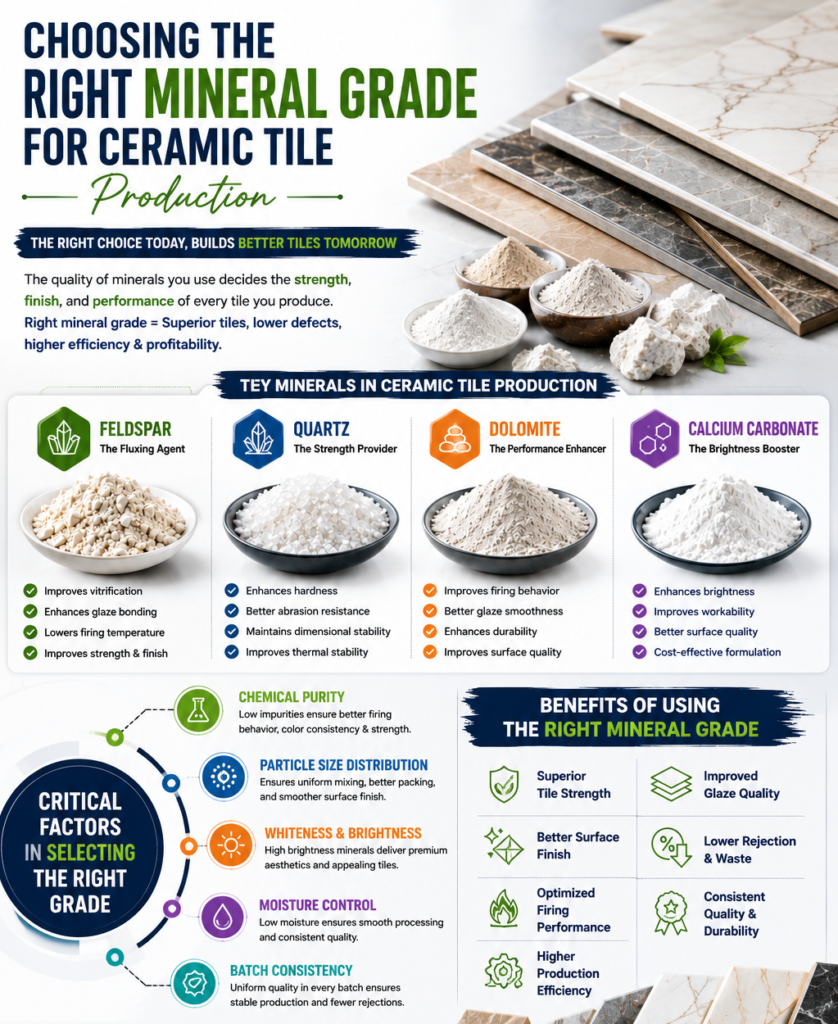
Key Minerals Used in Ceramic Tile Production
Feldspar: The Essential Fluxing Mineral
Feldspar is one of the most important minerals used in ceramic bodies and glazes. It acts as a natural flux, lowering the melting temperature during firing and promoting vitrification.
Benefits of high-quality feldspar include:
- Improved tile strength
- Better glaze bonding
- Reduced firing temperatures
- Enhanced surface finish
- Increased production efficiency
Manufacturers should prioritize feldspar grades with low iron content, controlled alkali levels, and consistent particle size distribution to achieve brighter and defect-free ceramic products.
Quartz Powder: Improving Structural Stability
Quartz plays a vital role in maintaining dimensional stability during firing. It helps control shrinkage while improving the mechanical strength of ceramic tiles.
Advantages of premium quartz powder include:
- Enhanced hardness
- Better abrasion resistance
- Reduced deformation during firing
- Improved thermal stability
- Consistent tile dimensions
Selecting high-purity quartz with controlled particle size ensures optimal performance throughout the manufacturing process.
Dolomite: Enhancing Durability and Surface Quality
Dolomite contributes magnesium and calcium to ceramic formulations, helping improve thermal performance and glaze characteristics.
Benefits include:
- Improved firing behavior
- Better glaze smoothness
- Enhanced tile durability
- Increased resistance to thermal shock
- Improved surface finish
High-purity dolomite grades can also contribute to improved whiteness and aesthetic appeal in finished tiles.
Calcium Carbonate: Improving Whiteness and Workability
Calcium carbonate is commonly used in ceramic formulations to improve processing characteristics and finished product appearance.
Its benefits include:
- Enhanced brightness
- Better workability
- Improved surface quality
- Controlled firing properties
- Cost-effective formulation optimization
Micronized calcium carbonate grades provide superior dispersion and consistency throughout production.
Critical Factors When Choosing a Mineral Grade
Chemical Purity
The chemical composition of industrial minerals directly affects firing behavior, glaze quality, and tile appearance. Minerals with excessive impurities may result in discoloration, defects, and inconsistent production results.
Manufacturers should seek:
- Low iron content
- Controlled silica levels
- Consistent chemical composition
- Minimal contamination
Particle Size Distribution
Particle size distribution influences packing density, sintering behavior, and surface finish.
Benefits of controlled particle size include:
- Better dispersion
- Uniform mixing
- Improved pressing characteristics
- Enhanced firing consistency
- Smoother tile surfaces
Whiteness and Brightness
For premium ceramic tiles, whiteness is often a critical quality parameter. High-brightness mineral grades help achieve cleaner color tones and improved aesthetic appeal.
Moisture Control
Excess moisture in raw materials can create processing challenges and impact product consistency. Reliable mineral suppliers maintain strict moisture control throughout production and packaging.
Batch-to-Batch Consistency
Consistency is essential for large-scale ceramic manufacturers. Variations in mineral quality can lead to production instability, increased waste, and inconsistent product performance.
Reliable mineral suppliers implement strict quality control measures to ensure uniformity across every batch.
How High-Quality Minerals Improve Ceramic Tile Performance
When the right mineral grades are selected, manufacturers can achieve:
- Superior tile strength
- Better dimensional stability
- Enhanced glaze quality
- Improved firing efficiency
- Reduced rejection rates
- Consistent color and finish
- Lower production costs
- Improved customer satisfaction
The result is a ceramic tile that not only looks better but also performs better throughout its service life.
Why Partnering with the Right Mineral Supplier Matters
The quality of ceramic tiles depends heavily on the quality of the minerals used in production. Working with an experienced mineral manufacturer ensures access to:
- High-purity raw materials
- Consistent particle size distribution
- Reliable supply chain support
- Technical expertise
- Customized mineral solutions
A trusted supplier helps ceramic manufacturers maintain product quality while improving operational efficiency and profitability.
SVI Industries: Delivering High-Performance Minerals for Ceramic Manufacturing
At SVI Industries, we supply premium-grade feldspar, quartz powder, dolomite, and calcium carbonate designed to meet the demanding requirements of modern ceramic tile manufacturers.
Our mineral solutions are carefully processed to deliver:
- Consistent quality
- Low impurity levels
- Controlled particle size
- High brightness
- Reliable performance
With a strong focus on quality, innovation, and customer success, SVI Industries helps ceramic manufacturers produce tiles that meet the highest standards of durability, aesthetics, and performance.
Conclusion
Selecting the right mineral grade is one of the most important factors in successful ceramic tile production. High-quality feldspar, quartz, dolomite, and calcium carbonate contribute directly to tile strength, glaze finish, manufacturing efficiency, and overall product quality.
As competition within the ceramic industry continues to grow, manufacturers who prioritize superior mineral selection gain a significant advantage in performance, consistency, and long-term profitability.