
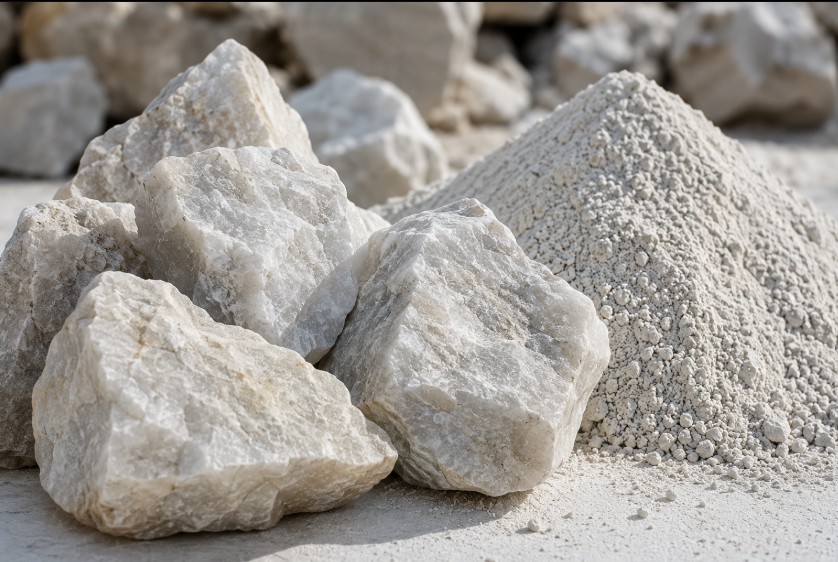
In induction furnace operations, ramming mass forms a critical refractory lining between molten metal and the furnace structure. Its performance can influence lining stability, furnace availability, maintenance requirements, and overall operating reliability.
However, the performance of ramming mass does not begin when the finished material reaches the furnace. It begins much earlier, with the selection of quartzite used as the primary raw material.
Quartzite deposits can differ significantly in chemical composition, mineralogical characteristics, impurities, weathering, and physical structure. Two quartzite rocks may appear almost identical to the eye while behaving very differently when processed and exposed to demanding furnace conditions.
This is why careful quartzite selection is an important first step in producing consistent, high-quality silica ramming mass.
Why Quartzite Quality Matters in Ramming Mass
Silica-based ramming mass is commonly used as a refractory lining material in induction furnaces. During furnace operation, the lining must withstand demanding thermal conditions while maintaining sufficient structural integrity to contain molten metal.
The quartzite used to manufacture the ramming mass therefore needs to be evaluated for more than appearance or availability.
Important considerations include:
- Silica content
- Type and concentration of impurities
- Mineralogical characteristics
- Physical integrity of the rock
- Degree of weathering
- Consistency of the raw-material source
- Suitability for the intended refractory formulation
The characteristics of the original quartzite continue to matter even after the material has been crushed, graded, blended, and prepared as ramming mass.
High Silica Content: The Starting Point
One of the first parameters considered when evaluating quartzite for silica ramming mass is its SiO₂ content.
High-purity quartzite provides the silica-rich base required for this type of refractory material. However, evaluating quartzite solely on the basis of a single SiO₂ percentage can be misleading.
The remaining chemical composition matters as well.
A quartzite sample with high silica content may still contain undesirable concentrations of iron, alumina, alkalis, calcium compounds, or other minerals. Depending on their type and concentration, these constituents can influence the material’s high-temperature behavior.
Therefore, a proper evaluation should consider the complete chemical profile, not simply the headline silica number.
Impurities Can Change Material Behavior
Natural quartzite is a geological material, not a manufactured chemical. Its composition can vary from one deposit to another and, in some cases, even within different sections of the same deposit.
Impurities may occur as visible inclusions or may be distributed within the mineral structure.
For ramming mass manufacturers, this makes raw-material sorting and quality control particularly important.
Controlling impurities helps manufacturers maintain a more predictable raw-material base from which the final refractory formulation can be produced.
The objective is not simply to find white-looking rock. It is to identify quartzite with the chemical and physical characteristics required for the intended application.
Why Weathered Quartzite Requires Careful Evaluation
Quartzite exposed to prolonged environmental conditions can undergo physical and chemical weathering.
Weathered material may show characteristics such as discoloration, altered mineral zones, cracks, increased porosity, or weakened structural integrity. These changes may make portions of a deposit less desirable for demanding refractory applications.
This is one reason visual inspection can be useful during quarry selection and sorting, but visual inspection alone is not sufficient.
Material that appears acceptable should still be supported by appropriate testing and quality-control procedures.
For ramming mass production, selecting sound and suitable quartzite helps establish a more consistent foundation for subsequent crushing, grading, blending, and processing.
From Quartzite Rock to Ramming Mass
Producing ramming mass is not simply a matter of grinding quartzite into powder.
The process begins with the raw material and continues through several controlled stages:
Quartzite Selection → Sorting and Impurity Control → Crushing → Particle Classification → Grading and Blending → Quality Control → Finished Ramming Mass
Each stage has a specific purpose.
Once suitable quartzite has been selected, controlled crushing reduces the material to the required particle sizes. The resulting fractions can then be classified and combined according to the desired particle-size distribution.
This grading is particularly important because ramming mass contains particles of different sizes rather than one uniform powder.
Coarser particles contribute to the structural framework, while intermediate and finer fractions occupy spaces between larger particles. An appropriate particle-size distribution supports effective packing and compaction during furnace lining installation.
Raw-material quality and particle engineering therefore work together.
The Connection Between Quartzite and Furnace Lining Performance
Inside an induction furnace, ramming mass is subjected to conditions very different from those experienced during storage or transportation.
After installation and compaction, the lining undergoes controlled heating and develops different thermal zones during operation. The material must accommodate high temperatures and repeated operating cycles while maintaining the required lining characteristics.
Several factors ultimately influence lining performance, including:
Raw-material quality
The chemical and mineralogical characteristics of the quartzite establish the foundation.
Particle-size distribution
The balance between coarse, intermediate, and fine particles affects packing and compaction.
Installation practices
Even well-manufactured ramming mass requires proper installation and uniform compaction.
Sintering procedure
The initial heating schedule contributes to the development of the working lining.
Furnace operating conditions
Metal chemistry, temperature, operating practices, slag conditions, and thermal cycling can all influence lining life.
For this reason, no responsible manufacturer should suggest that quartzite quality alone determines furnace campaign life.
But it remains one of the fundamental variables because you cannot correct unsuitable raw material simply through better packaging or presentation of the finished product.
Consistency Is as Important as Purity
Industrial buyers require more than one excellent sample.
They need repeatability.
If the characteristics of quartzite vary substantially between production lots, the resulting ramming mass may also become more difficult to keep consistent.
A disciplined raw-material program therefore considers both quality and continuity.
This can involve evaluating incoming quartzite, monitoring chemical composition, controlling contamination, maintaining defined particle-size distributions, and testing finished batches according to established specifications.
For steel plants and foundries, this consistency can be just as important as achieving an impressive result on a single laboratory report.
Selecting Ramming Mass Should Begin with Questions About the Raw Material
When evaluating a ramming mass supplier, buyers can look beyond the finished bag and ask questions such as:
- What type of quartzite is being used?
- How is the quartzite selected?
- Is the chemical composition regularly monitored?
- How are impurities controlled?
- How is particle-size distribution maintained?
- What quality checks are performed on finished material?
- How is batch-to-batch consistency managed?
These questions help shift procurement from simply comparing price per tonne to understanding the material and process behind the product.
SVI’s Approach to Quartzite Selection
At SVI Industries, the production of quartz-based ramming mass begins with careful attention to the quartzite entering the process.
Raw-material selection is followed by controlled processing, particle sizing, grading, and quality checks to produce ramming mass for industrial furnace applications.
The objective is straightforward: build consistency into the product from the beginning of the manufacturing process rather than attempting to inspect quality only at the end.
For customers, understanding the quartzite behind the ramming mass provides another important perspective when evaluating refractory materials for their operations.
Quality Begins Before Manufacturing
A finished bag of ramming mass represents the final stage of a much longer process.
Before crushing, grading, blending, testing, packaging, and dispatch, there is one fundamental decision:
Which quartzite should enter the process in the first place?
High silica content matters. Impurity control matters. Mineral characteristics matter. Physical condition matters. And consistency across the raw-material source matters.
For demanding furnace applications, not every quartzite deposit is suitable.
Reliable ramming mass starts with the right quartzite, because furnace lining performance is built from the raw material upward.