
Ceramic manufacturing is a carefully balanced combination of raw materials, process control, and thermal engineering. While clay provides plasticity and quartz contributes structural stability, one ingredient quietly plays a transformative role during firing—feldspar powder.
Known as a natural flux, feldspar is one of the most important raw materials used in ceramic bodies. Its ability to promote vitrification, reduce porosity, improve strength, and enhance surface quality makes it indispensable in the production of ceramic tiles, sanitaryware, tableware, porcelain, and technical ceramics.
This article explores what a flux is, why it matters, and how feldspar powder contributes to producing high-performance ceramic products.
What Is a Flux?
A flux is a material that lowers the melting temperature of a ceramic body during firing. Instead of requiring every component to melt at extremely high temperatures, a flux begins to soften and melt earlier, creating a liquid (glassy) phase within the ceramic body.
This liquid phase flows between solid particles, filling microscopic voids and binding them together. As firing continues, the body becomes denser, stronger, and less porous—a process known as vitrification.
Without an effective flux, ceramic products would require higher firing temperatures, consume more energy, and often exhibit inferior physical properties.
Why Feldspar Is the Preferred Natural Flux
Feldspar is one of the most widely used fluxing materials because it naturally contains alkali oxides such as potassium oxide (K₂O) and sodium oxide (Na₂O). These oxides reduce the melting temperature of ceramic bodies and encourage the formation of a stable glassy phase during firing.
Compared with many alternative fluxes, feldspar offers several advantages:
- Consistent fluxing performance
- Excellent compatibility with ceramic body formulations
- Improved densification during firing
- Reliable mechanical performance
- Better dimensional stability
- Enhanced surface finish
These characteristics make feldspar suitable for a broad range of ceramic applications.
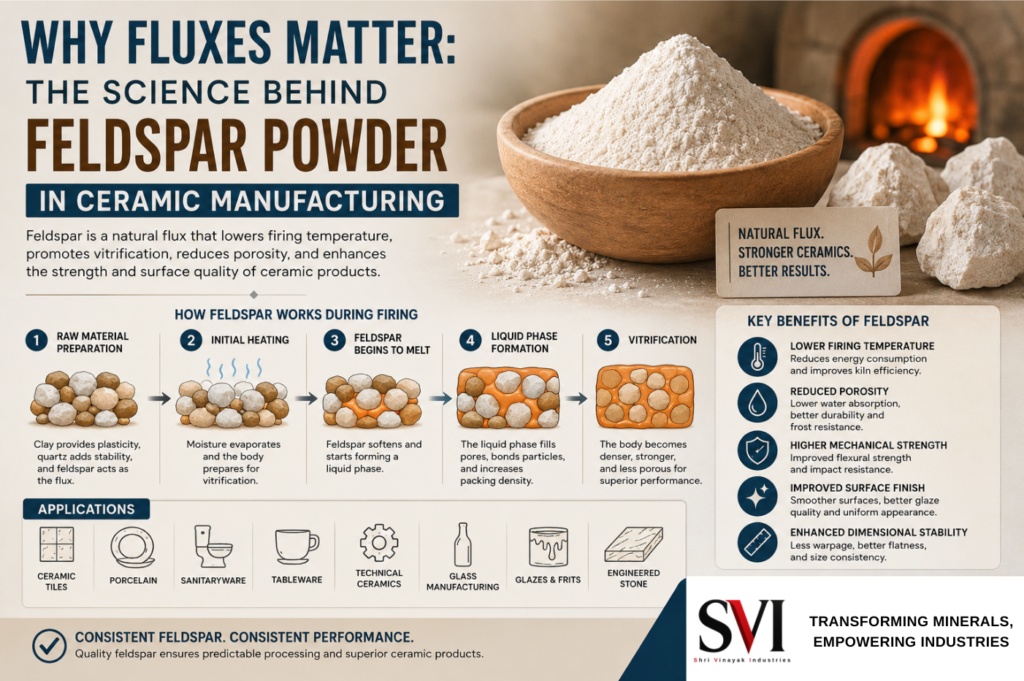
How Feldspar Works During Firing
The role of feldspar becomes increasingly important as kiln temperatures rise.
Stage 1: Raw Material Preparation
The ceramic body contains a carefully balanced mixture of clay, quartz, feldspar, and other functional minerals.
Each material has a specific purpose:
- Clay provides plasticity for shaping.
- Quartz helps maintain dimensional stability.
- Feldspar acts as the flux.
Stage 2: Initial Heating
As the temperature increases, moisture evaporates and organic materials burn away.
The ceramic body begins preparing for vitrification.
Stage 3: Feldspar Begins to Melt
At elevated temperatures, feldspar softens and gradually forms a liquid glassy phase.
Unlike quartz, which remains relatively stable during this stage, feldspar actively transforms.
Stage 4: Liquid Phase Formation
The molten feldspar spreads between ceramic particles.
This liquid phase:
- fills microscopic pores,
- bonds adjacent particles,
- increases packing density,
- strengthens the ceramic structure.
Stage 5: Vitrification
As firing continues, the ceramic body becomes denser and more compact.
The reduction in pore volume improves both physical and mechanical properties.
The result is a stronger, more durable ceramic product.
Key Benefits of Feldspar as a Flux
1. Lower Firing Temperature
Feldspar reduces the temperature required to achieve vitrification.
Benefits include:
- Lower fuel consumption
- Reduced energy costs
- Improved kiln efficiency
- Better production economics
2. Reduced Porosity
The glassy phase created by feldspar fills voids between particles.
Lower porosity leads to:
- Reduced water absorption
- Improved frost resistance
- Better chemical resistance
- Increased durability
3. Higher Mechanical Strength
A denser ceramic body has fewer structural weaknesses.
This contributes to:
- Higher flexural strength
- Better impact resistance
- Reduced breakage during handling
4. Improved Surface Finish
Better vitrification produces smoother surfaces that support:
- Improved glaze quality
- Better brightness
- More uniform appearance
- Reduced surface defects
5. Enhanced Dimensional Stability
Controlled vitrification helps ceramic products retain their intended dimensions during firing.
Manufacturers benefit from:
- Reduced warpage
- Better flatness
- Improved size consistency
- Lower rejection rates
Feldspar and Porosity
One of feldspar’s most significant contributions is its effect on porosity.
Porosity influences:
- Water absorption
- Mechanical strength
- Durability
- Surface quality
- Long-term performance
By promoting liquid phase formation, feldspar reduces interconnected open pores and helps produce a dense ceramic body with superior performance characteristics.
Why Consistent Feldspar Quality Matters
The performance of feldspar depends not only on its chemical composition but also on its consistency.
Manufacturers typically evaluate:
- Chemical composition
- Particle size distribution
- Moisture content
- Loss on Ignition (LOI)
- Iron content
- Batch-to-batch consistency
Maintaining control over these parameters helps ensure predictable firing behaviour and repeatable product quality.
Applications That Depend on Feldspar
High-quality feldspar powder is widely used in:
- Ceramic tiles
- Porcelain
- Sanitaryware
- Tableware
- Technical ceramics
- Glass manufacturing
- Glazes and frits
- Engineered stone
In each application, feldspar contributes to improved processing efficiency and enhanced product performance.
Choosing the Right Feldspar Supplier
Selecting a feldspar supplier should involve more than comparing prices.
Manufacturers should evaluate:
- Consistency of raw materials
- Quality control procedures
- Technical expertise
- Reliable supply capability
- Documentation and traceability
- Ability to maintain long-term batch consistency
A dependable supplier helps manufacturers reduce production variability while improving overall process stability.
Conclusion
Feldspar is far more than a basic raw material—it is a critical engineering component that influences nearly every stage of ceramic production.
Its ability to lower firing temperatures, promote vitrification, reduce porosity, improve mechanical strength, and enhance surface finish makes it one of the most valuable materials in modern ceramic manufacturing.
For manufacturers focused on quality, efficiency, and consistency, selecting the right feldspar is an important step toward producing stronger, more reliable ceramic products.
At EON Enterprises, we are committed to supplying high-quality feldspar powders that help manufacturers achieve predictable processing, consistent performance, and superior finished products.