
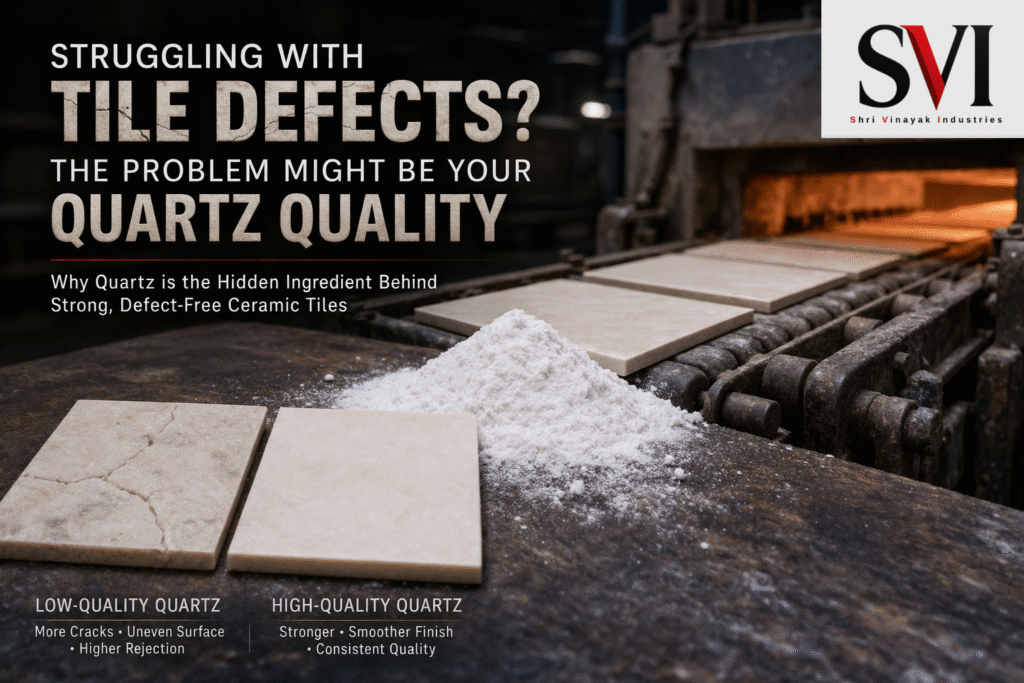
In the ceramic tile industry, raw material quality defines everything, from strength and durability to surface finish and consistency. Among all the materials used in tile production, quartz plays a critical role in determining the final performance of ceramic tiles.
For manufacturers aiming to produce high-quality tiles at scale, quartz is not just an additive, it is a core functional component of the ceramic body.
At Shri Vinayak Industries (SVI), we supply processed quartz that supports ceramic manufacturers in achieving consistent production, reduced defects, and superior tile quality.
What Role Does Quartz Play in Ceramic Tiles?
Quartz (SiO₂) is added to ceramic tile compositions to enhance both mechanical and thermal properties.
It acts as a:
– Filler material that improves structure
– Stabilizer during firing
– Strength enhancer in the final product
Unlike clay, which shrinks during firing, quartz helps control dimensional stability making it essential in tile manufacturing.
Key Benefits of Quartz in Ceramic Tile Production
1. Improves Strength and Durability
Quartz increases the mechanical strength of ceramic tiles.
- Enhances resistance to cracks and breakage
- Improves load-bearing capacity
- Ensures long-lasting tiles
This is especially important for floor tiles and high-traffic areas.
Controls Shrinkage During Firing
One of the biggest challenges in ceramic manufacturing is shrinkage during kiln firing.
Quartz helps:
- Maintain tile shape and size
- Prevent warping and deformation
- Ensure dimensional accuracy
This leads to uniform tiles with minimal rejection rates.
Enhances Surface Finish
Quartz contributes to a smoother and more refined surface.
- Improves texture and uniformity
- Supports better glazing results
- Enhances aesthetic appeal
For premium tiles, surface quality is a key differentiator — and quartz plays a major role.
4. Improves Thermal Stability
Ceramic tiles undergo high-temperature firing, and quartz ensures stability during this process.
- Withstands high kiln temperatures
- Prevents structural failure
- Maintains consistency across batches
5. Supports Efficient Production
Consistent quartz quality ensures smoother manufacturing.
- Better mixing and bonding
- Reduced machine wear
- Fewer production interruptions
This directly improves operational efficiency and output consistency.
Why Quartz Quality Matters in Ceramic Manufacturing
Not all quartz is suitable for ceramic tiles.
Low-quality quartz can cause:
- Color inconsistency
- Weak tiles
- Surface defects
- High rejection rates
Critical Quality Parameters:
- High SiO₂ purity
- Low iron content (Fe₂O₃)
- Consistent particle size (granulometry)
- High whiteness index
These factors directly impact the visual and structural quality of tiles.
How Shri Vinayak Industries Supports Ceramic Manufacturers
At SVI, we understand the exact needs of ceramic tile producers.
Our quartz processing focuses on:
- Controlled particle size distribution for uniform mixing
- Low impurity levels for better whiteness
- Consistent batch quality to eliminate variation
- Reliable bulk supply to ensure uninterrupted production
We don’t just supply quartz, we help manufacturers optimize their production process.
Why Consistency in Quartz Supply is a Competitive Advantage
In large-scale tile manufacturing, even small variations in raw material can lead to major issues.
- Consistent quartz supply ensures:
- Uniform tile appearance
- Reduced rejection rates
- Predictable production outcomes
- This ultimately leads to:
- Higher profitability
- Stronger brand positioning
- Better customer satisfaction