
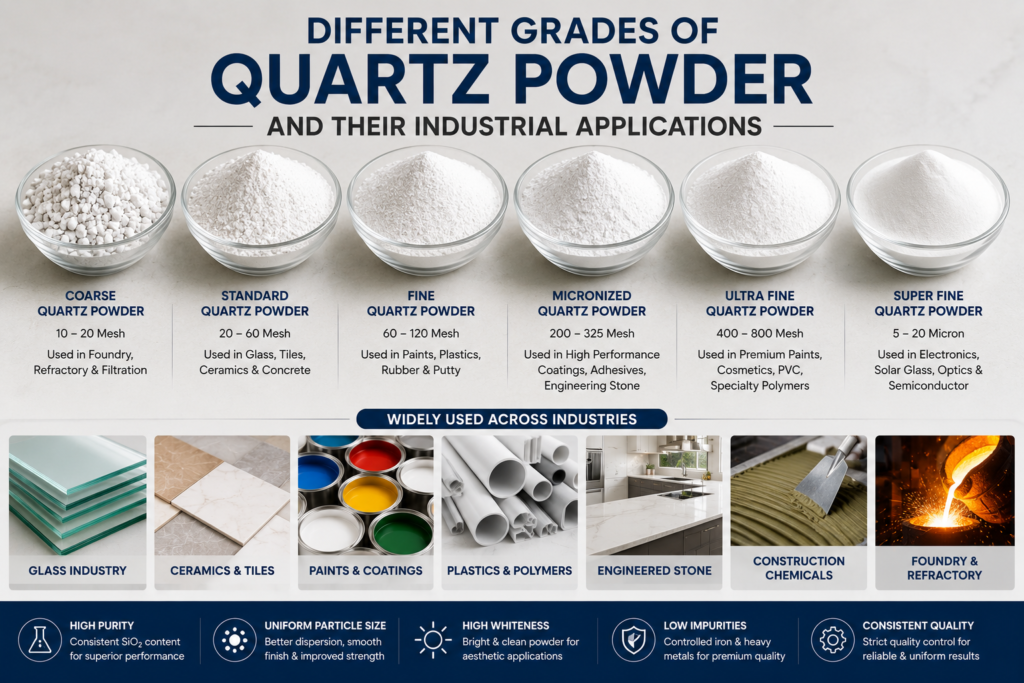
Quartz powder is one of the most versatile industrial minerals used across modern manufacturing. From ceramics and engineered stone to paints, plastics, glass, construction chemicals, and electronics, manufacturers rely on high-quality quartz powder to improve product performance, durability, and consistency.
However, not all quartz powder is the same. Different industries require different grades based on factors such as silica purity, particle size, whiteness, moisture content, and chemical composition. Choosing the correct quartz powder grade can significantly influence production efficiency, surface finish, mechanical strength, and the overall quality of the finished product.
Understanding these grades helps manufacturers select the right material for their specific application while maximizing performance and minimizing production costs.
What Is Quartz Powder?
Quartz powder is produced by crushing, grinding, and classifying naturally occurring quartz into fine and micronized particles. High-quality quartz powder contains a high percentage of silicon dioxide (SiO₂), making it suitable for demanding industrial applications.
The quality of quartz powder depends on several important characteristics:
- High silica content
- Low iron impurities
- Uniform particle size distribution
- High brightness and whiteness
- Low moisture content
- Consistent chemical composition
Modern micronization technology allows manufacturers to produce quartz powder in multiple mesh sizes and micron grades for specialized industrial requirements.
Why Choosing the Right Quartz Grade Matters
Every manufacturing process has unique technical requirements. Using the wrong quartz grade can result in:
- Poor surface finish
- Inconsistent color
- Reduced product strength
- Processing difficulties
- Increased material wastage
- Higher rejection rates
Selecting the appropriate grade improves production efficiency while delivering consistent product quality.
Major Quartz Powder Grades
High-Purity Quartz Powder
High-purity quartz contains exceptionally high silica content with minimal impurities such as iron, aluminum, and titanium.
This grade is widely preferred where optical clarity, chemical stability, and electrical performance are essential.
Common Applications
- Solar glass
- Specialty glass
- Electronics
- Semiconductor components
- Optical products
- High-performance ceramics
Micronized Quartz Powder
Micronized quartz is manufactured using advanced grinding and air classification systems to achieve extremely fine particle sizes.
Its uniform particle distribution provides:
- Better dispersion
- Improved surface smoothness
- Enhanced mechanical strength
- Superior processing characteristics
Applications
- Decorative paints
- Powder coatings
- Construction chemicals
- Adhesives
- Polymer compounds
- Epoxy flooring
Ceramic Grade Quartz Powder
Ceramic manufacturers require quartz with controlled particle size and low iron content.
Benefits include:
- Improved vitrification
- Better tile strength
- Enhanced glaze quality
- Controlled shrinkage
- Excellent surface finish
It is widely used in:
- Ceramic tiles
- Sanitaryware
- Porcelain products
- Tableware
- Technical ceramics
Glass Grade Quartz Powder
Glass manufacturing demands quartz with exceptional purity and low contamination levels.
High-quality glass grade quartz contributes to:
- Improved transparency
- Better chemical resistance
- Increased durability
- Reduced defects
- Stable melting characteristics
Applications include:
- Float glass
- Container glass
- Decorative glass
- Solar glass
- Laboratory glassware
Engineered Stone Grade Quartz Powder
Engineered quartz surfaces require precisely graded quartz particles to achieve strength and visual appeal.
Premium grades offer:
- Excellent hardness
- Superior polishability
- Better stain resistance
- Consistent color
- Improved dimensional stability
These grades are extensively used in:
- Quartz countertops
- Engineered slabs
- Kitchen surfaces
- Interior décor products
Foundry Grade Quartz Powder
Foundry industries use specially processed quartz for molding and refractory applications.
Its high thermal resistance supports:
- Better mold strength
- Improved casting accuracy
- Enhanced thermal stability
- Reduced metal contamination
Construction Grade Quartz Powder
Construction chemicals use quartz powder to improve strength, wear resistance, and workability.
Typical applications include:
- Tile adhesives
- Wall putty
- Dry mix mortars
- Waterproofing compounds
- Self-leveling flooring
- Cement-based products
Paint and Coating Grade Quartz Powder
In paints and coatings, quartz powder functions as a high-performance functional filler.
It helps improve:
- Abrasion resistance
- Scratch resistance
- Surface smoothness
- Weather durability
- Opacity
- Coating consistency
It is widely used in industrial coatings, decorative paints, powder coatings, and protective finishes.
Plastic and Polymer Grade Quartz Powder
Quartz powder is increasingly used in plastic compounds to improve both mechanical performance and processing behavior.
Benefits include:
- Higher rigidity
- Better dimensional stability
- Improved heat resistance
- Enhanced surface quality
- Reduced shrinkage
Applications include PVC products, engineering plastics, masterbatches, and polymer composites.
Factors That Determine Quartz Powder Quality
Selecting the right quartz powder involves more than choosing a mesh size. Manufacturers should evaluate several critical quality parameters.
Silica Purity
Higher SiO₂ content generally delivers better performance, particularly in glass, ceramics, and electronics.
Low Iron Content
Low iron levels improve whiteness and prevent discoloration in ceramic, glass, and decorative applications.
Particle Size Distribution
Uniform particle size ensures better mixing, improved processing, and consistent product quality.
Brightness and Whiteness
High-brightness quartz enhances the visual appearance of paints, tiles, engineered stone, and construction materials.
Moisture Control
Low moisture improves storage stability and manufacturing efficiency.
Batch Consistency
Consistent mineral quality ensures predictable performance and reduces production variability.
How Premium Quartz Powder Improves Manufacturing
Manufacturers using high-quality quartz powder experience numerous production advantages:
- Better surface finish
- Improved product strength
- Increased abrasion resistance
- Higher production efficiency
- Reduced material wastage
- Lower rejection rates
- Improved dimensional stability
- Consistent batch quality
These benefits contribute directly to lower manufacturing costs and higher customer satisfaction.
Why Choose SVI Industries?
At SVI Industries, we manufacture premium-quality quartz powder using carefully selected raw materials and advanced mineral processing technology.
Our quartz powder is available in multiple grades and particle sizes to meet the requirements of diverse industries, including:
- Ceramics
- Glass
- Engineered stone
- Paints and coatings
- Plastics and polymers
- Construction chemicals
- Refractory applications
Every batch is processed under stringent quality control to ensure high silica content, controlled particle size distribution, low impurity levels, and consistent performance.
Our commitment to quality enables manufacturers to achieve superior product performance while optimizing production efficiency.
Conclusion
Quartz powder is much more than a basic industrial mineral. The right grade plays a crucial role in determining the strength, appearance, durability, and processing efficiency of countless manufactured products.
Whether producing ceramic tiles, engineered stone, decorative coatings, plastics, glass, or construction materials, selecting the appropriate quartz powder grade is essential for achieving consistent quality and long-term manufacturing success.
With advanced processing capabilities and a strong focus on purity and consistency, SVI Industries delivers high-performance quartz powder solutions trusted by manufacturers across a wide range of industries.