
As manufacturers continue to focus on improving production efficiency while lowering operating costs, every raw material in the manufacturing process is being evaluated for its contribution to energy savings. One mineral that has a surprisingly significant impact on energy efficiency is feldspar.
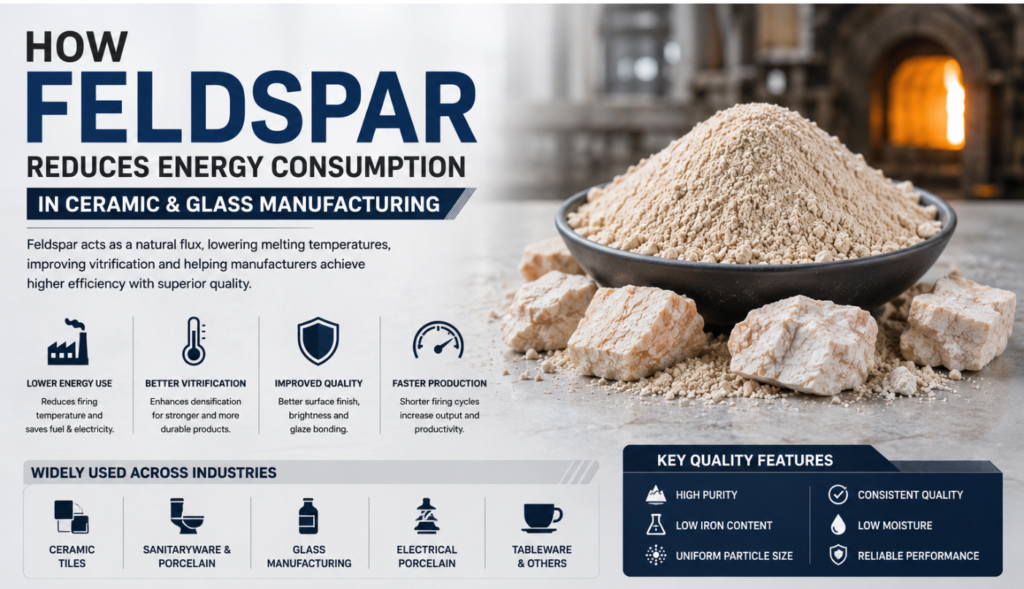
Widely used in ceramics, glass, sanitaryware, porcelain, and engineered materials, feldspar is much more than a raw material. It functions as a natural flux that lowers melting temperatures, improves vitrification, and reduces the overall energy required during production.
For manufacturers operating energy-intensive kilns and furnaces, selecting the right feldspar grade can directly improve profitability while enhancing product quality.
Understanding Feldspar’s Role in Manufacturing
Feldspar is one of the most abundant aluminosilicate minerals found in the Earth’s crust. Industrial feldspar contains varying proportions of potassium, sodium, aluminum, and silica, making it an indispensable ingredient in ceramic and glass formulations.
Its greatest advantage lies in its ability to act as a fluxing agent.
Rather than serving only as a filler, feldspar actively promotes the formation of a glassy phase during firing, allowing ceramic bodies and glass batches to mature at lower temperatures.
This seemingly small chemical contribution translates into significant industrial benefits.
Why Lower Firing Temperatures Matter
In ceramic and glass manufacturing, furnaces operate continuously at temperatures ranging from 1,100°C to over 1,500°C.
Every reduction in firing temperature offers measurable advantages:
- Lower electricity consumption
- Reduced fuel usage
- Faster production cycles
- Lower carbon emissions
- Reduced kiln wear
- Higher equipment life
The correct feldspar grade helps manufacturers achieve these benefits without compromising product quality.
How Feldspar Improves Vitrification
Vitrification is the process where ceramic materials become dense, hard, and nearly non-porous during firing.
High-quality feldspar melts gradually during heating and forms a liquid glass phase that binds other raw materials together.
This results in:
- Higher tile strength
- Better glaze adhesion
- Lower water absorption
- Improved surface finish
- Better mechanical properties
Efficient vitrification also reduces firing defects such as pinholes, cracks, and warping.
Benefits of High-Quality Feldspar
Lower Energy Costs
Because feldspar lowers the melting point of ceramic bodies, manufacturers require less energy to achieve complete vitrification.
For large-scale production facilities, even small improvements in firing efficiency translate into substantial annual energy savings.
Faster Manufacturing
Reduced firing temperatures often allow shorter kiln cycles, increasing production capacity without investing in additional equipment.
Improved Product Quality
Premium feldspar contributes to:
- Brighter ceramic bodies
- Uniform glaze finish
- Better dimensional stability
- Improved strength
- Reduced production defects
Longer Kiln Life
Operating at optimized temperatures reduces thermal stress on kiln refractories and equipment, extending maintenance intervals and lowering repair costs.
Choosing the Right Feldspar Grade
Not every feldspar performs the same.
Manufacturers should evaluate several technical parameters before selecting a supplier.
Low Iron Content
Lower iron levels produce cleaner white ceramic bodies and transparent glass.
Controlled Alkali Content
Balanced potassium and sodium levels improve fluxing performance.
High Purity
Low impurity levels minimize firing defects and improve consistency.
Uniform Particle Size
Fine and consistent grinding ensures better mixing and predictable firing behavior.
Low Moisture
Stable moisture levels improve storage and processing efficiency.
Batch Consistency
Uniform mineral quality reduces production variability and minimizes rejection rates.
Industries That Benefit from Premium Feldspar
High-performance feldspar is widely used in:
Ceramic Tiles
Improves vitrification, glaze bonding, and strength.
Sanitaryware
Enhances whiteness and firing consistency.
Porcelain
Provides excellent translucency and dimensional stability.
Glass Manufacturing
Improves melting behavior while reducing furnace energy requirements.
Electrical Porcelain
Offers excellent dielectric performance and mechanical strength.
Tableware
Produces smoother surfaces and brighter finished products.
Why Manufacturers Prefer Premium Feldspar
Manufacturers increasingly choose engineered feldspar because it offers:
- Consistent chemistry
- Better firing behavior
- Improved energy efficiency
- Lower rejection rates
- Higher productivity
- Better return on investment
Rather than viewing feldspar as a commodity, leading ceramic producers now consider it a strategic raw material that directly affects production costs and product quality.
Premium Feldspar Solutions from SVI Industries
SVI Industries manufactures high-quality feldspar powder using carefully selected mineral deposits and advanced processing technology.
Our feldspar products are engineered to provide:
- High purity
- Low iron content
- Controlled particle size distribution
- Excellent whiteness
- Consistent alkali composition
- Reliable batch-to-batch quality
These characteristics help ceramic and glass manufacturers improve production efficiency while achieving superior finished products.
Conclusion
Energy efficiency has become one of the most important priorities for modern manufacturing industries. High-quality feldspar contributes directly to this goal by reducing firing temperatures, improving vitrification, enhancing product quality, and lowering overall production costs.
For ceramic and glass manufacturers seeking higher productivity, improved consistency, and long-term cost savings, selecting the right feldspar grade is a strategic investment rather than simply a raw material purchase.