
In industries where visual appearance, smooth texture, and long term durability are critical, micronized minerals play a far more important role than many realize. Whether it is a premium wall coating, an automotive finish, engineered plastic, ceramic tile, or construction material, the quality of the final surface often depends on the performance of ultra fine mineral additives working within the formulation.
Micronized minerals are specially processed industrial minerals engineered to achieve extremely fine particle sizes, typically below 20 microns. Unlike conventional coarse fillers, these minerals offer advanced functional benefits that improve smoothness, enhance strength, optimize processing behavior, and elevate overall surface quality.
Today, micronized minerals are considered essential performance ingredients rather than simple fillers. Their contribution directly influences how a surface looks, feels, performs, and withstands environmental stress over time.
What Are Micronized Minerals?
Micronized minerals are naturally occurring minerals processed using advanced grinding and classification technologies to achieve highly controlled ultra fine particle sizes. Common minerals used in micronized applications include:
• Quartz
• Feldspar
• Calcium Carbonate
• Talc
• Mica
• Dolomite
Through precision milling and air classification systems, these minerals are transformed into powders with:
• Highly uniform particle size distribution
• Increased surface area
• Superior brightness and purity
• Enhanced chemical stability
• Reliable formulation consistency
This refinement significantly changes how minerals interact with polymers, pigments, binders, and resins inside industrial formulations.
For instance, talc possesses a naturally lamellar structure that improves reinforcement and smoothness in plastics, while micronized calcium carbonate improves opacity and brightness in paints and coatings.
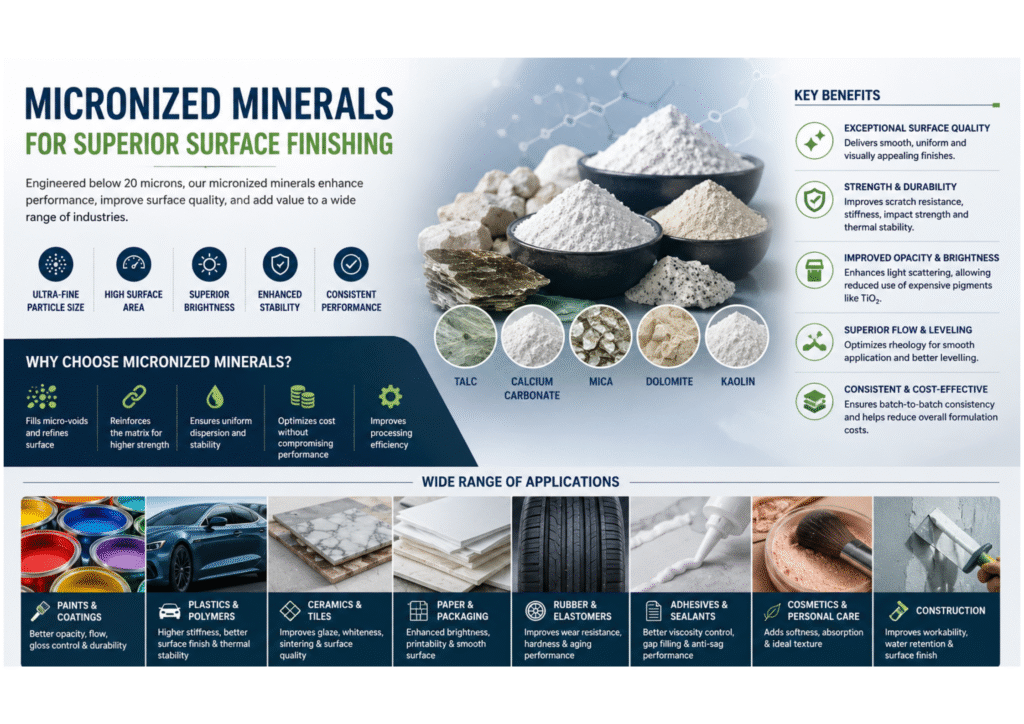
How Micronized Minerals Improve Surface Finishing
Surface Smoothness and Refinement
One of the biggest advantages of micronized minerals is their ability to fill microscopic surface irregularities. Their fine particle size helps create smoother, more uniform finishes that are essential for decorative coatings, glossy paints, engineered plastics, and ceramic surfaces.
These minerals help reduce imperfections such as:
• Micro pits
• Surface roughness
• Uneven texture
• Fine scratches
The result is improved gloss control, refined matte finishes, and superior surface appearance.
Enhanced Light Scattering and Opacity
Micronized minerals improve the optical performance of coatings by scattering light more evenly across the surface. Minerals such as micronized calcium carbonate contribute to higher whiteness and opacity, allowing manufacturers to reduce dependence on expensive pigments like Titanium Dioxide while maintaining visual quality.
This provides both aesthetic and economic advantages in decorative and industrial coatings.
Improved Strength and Durability
Different minerals contribute unique structural properties to a formulation.
• Talc improves stiffness and dimensional stability due to its plate like structure
• Mica enhances reinforcement and thermal resistance
• Dolomite contributes hardness and wear resistance
These characteristics improve:
• Scratch resistance
• Surface hardness
• Heat resistance
• Impact strength
• Reduced cracking and chipping
As a result, finished products achieve better long term durability and performance under demanding conditions.
Better Flow and Application Performance
Micronized minerals also influence rheology and application behavior. Their controlled particle size helps coatings spread more evenly and prevents issues such as sagging or uneven film formation.
Benefits include:
• Improved levelling
• Better flow characteristics
• Uniform coating thickness
• Enhanced suspension stability
• Smoother application during spraying or brushing
This is especially important in paints, adhesives, sealants, and construction coatings.
Consistency Across Production Batches
Uniform particle distribution helps manufacturers maintain consistency in color, gloss, texture, and mechanical properties across large production cycles. This reliability is critical in industries such as automotive coatings, packaging, ceramics, and branded consumer products.
The Science Behind Modern Micronization
Modern micronization involves much more than traditional grinding. Advanced mineral processing technologies combine:
• Precision milling
• Air classification
• Surface treatment
• Particle engineering
• Brightness enhancement
Surface modified minerals are designed to improve compatibility with polymer systems and resin matrices. Controlled particle size distribution helps manufacturers achieve targeted levels of opacity, reinforcement, gloss, and viscosity.
In high performance applications, nano mineral technologies provide even greater reinforcement, dispersion quality, and surface enhancement.
This scientific control allows formulators to achieve repeatable product performance with high reliability.
Key Benefits of Micronized Minerals
Exceptional Surface Quality
Ultra fine mineral particles fill microscopic voids and refine surface texture, resulting in smoother finishes and improved visual appeal.
Structural Reinforcement
Minerals such as talc and mica improve stiffness, tensile strength, thermal stability, and impact resistance in coatings and polymers.
Superior Dispersion
Their fine particle size ensures even integration throughout the formulation, minimizing streaking, settling, and inconsistent gloss.
Cost Effective Formulation
Micronized calcium carbonate allows partial replacement of expensive pigments without significantly affecting opacity or finish quality.
Functional Performance Improvements
Depending on the application, micronized minerals can provide:
• Improved scratch resistance
• Better abrasion resistance
• Anti blocking properties
• Enhanced barrier performance
• Improved sanding and polishing behavior
• Controlled rheology
Processing Efficiency
In plastics and polymers, micronized minerals improve mold filling, reduce shrinkage, and support smoother extrusion and injection molding operations.
Chemical Stability and Safety
Most industrial micronized minerals are naturally inert, chemically stable, and suitable for use across a wide range of industrial and consumer applications.
Industries Using Micronized Minerals
Paints and Coatings
Used to improve opacity, smoothness, durability, gloss control, and rheology in decorative and industrial coatings.
Plastics and Polymers
Enhance rigidity, dimensional stability, heat resistance, and surface appearance in engineering plastics and polymer compounds.
Ceramics and Tiles
Improve glaze smoothness, firing behavior, whiteness, and thermal shock resistance.
Construction Materials
Used in wall putties, cement products, waterproofing compounds, adhesives, and plasters to improve workability and surface finish.
Paper and Packaging
Improve print quality, brightness, and surface texture while reducing raw material costs.
Rubber and Sealants
Enhance wear resistance, hardness, and formulation stability.
Cosmetics and Personal Care
Minerals such as talc contribute softness, absorption, and texture enhancement in cosmetic formulations.
Advanced Mineral Solutions from SVI Industries
At SVI Industries, micronized mineral solutions are engineered to meet the evolving demands of modern manufacturing industries. Carefully processed mineral grades are developed for consistency, brightness, particle precision, and optimized industrial performance.
These engineered mineral solutions help manufacturers achieve improved surface finishing, enhanced durability, better processing efficiency, and cost effective formulation performance across multiple industries.