
In today’s advanced manufacturing environment, industries are constantly searching for materials that improve product strength, surface quality, processing efficiency, and long term durability without significantly increasing production costs. Among the most versatile industrial minerals meeting these demands is Talc.
Despite being known as the softest naturally occurring mineral, talc delivers remarkable performance across a wide range of industrial applications. Its unique plate like particle structure, chemical stability, hydrophobic behavior, and ultra fine particle size make it an essential functional additive in plastics, paints, coatings, ceramics, cosmetics, pharmaceuticals, paper, and construction products.
Today, talc is no longer viewed as a simple filler material. It has evolved into a high performance industrial mineral capable of improving formulation behavior, mechanical properties, dimensional stability, and overall product quality.
What Is Talc?
Talc is a naturally occurring hydrated magnesium silicate with the chemical formula:
Mg3Si4O10(OH)2Mg_{3}Si_{4}O_{10}(OH)_{2}Mg3Si4O10(OH)2
It is recognized for its exceptionally soft texture and layered crystal structure. On the Mohs hardness scale, talc ranks at the lowest hardness level, yet its industrial functionality is extremely valuable.
Its physical and chemical characteristics make it highly suitable for industrial processing and formulation enhancement.
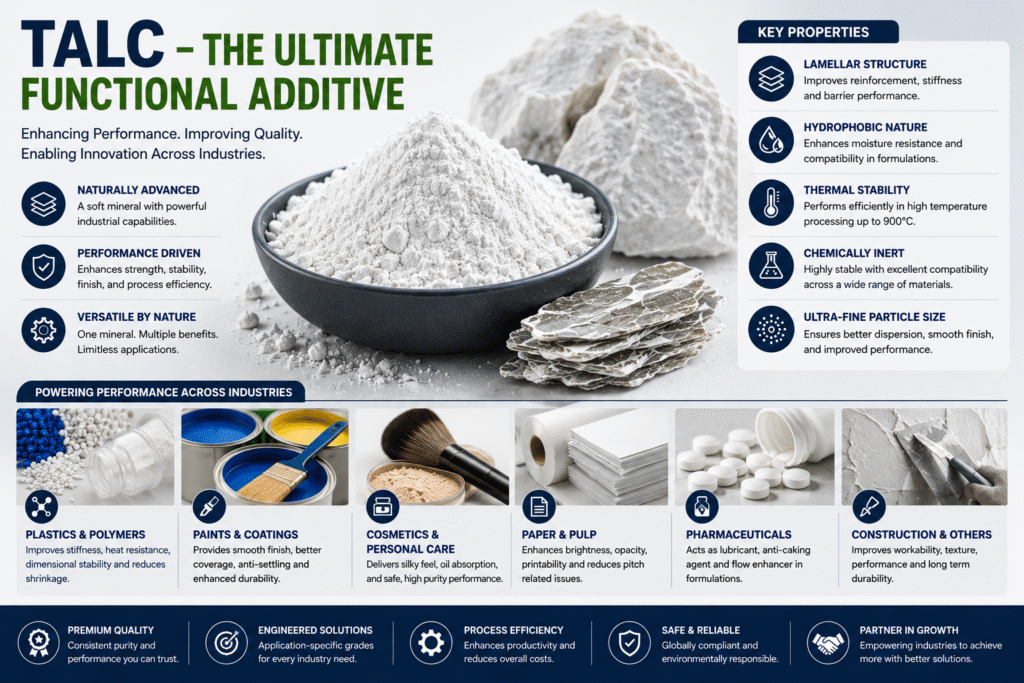
Key Properties That Make Talc Valuable
Plate Like Lamellar Structure
Talc particles naturally form flat layered plates that improve reinforcement and barrier performance inside polymers, coatings, and composites.
Hydrophobic Nature
Talc repels water, which helps improve moisture resistance, process stability, and compatibility in various formulations.
Thermal Stability
Talc performs effectively under high temperature processing conditions, making it ideal for plastics, automotive components, and industrial coatings.
Chemical Inertness
Its non reactive nature allows compatibility with a broad range of polymers, pigments, resins, and additives.
Ultra Fine Particle Size
Micronized talc improves dispersion, surface smoothness, opacity control, and processing consistency.
Industrial Applications of Talc
Talc in Plastics and Polymers
Talc is extensively used in thermoplastics and polymer compounds as a reinforcing mineral filler and nucleating agent.
Its addition improves:
• Stiffness and rigidity
• Heat deflection temperature
• Dimensional stability
• Impact resistance
• Surface finish quality
• Processing efficiency
In polypropylene and engineering plastics, talc also helps reduce shrinkage and warpage during molding operations.
Common Applications
• Automotive dashboards and interior parts
• Appliance housings
• Packaging materials
• Injection molded components
• PVC and polyolefin compounds
Ultra fine talc grades are especially beneficial in applications requiring improved printability, thermal performance, and controlled dimensional behavior.
Talc in Paints and Coatings
Talc plays a major role in improving both decorative and protective coating systems.
In paints and coatings, talc contributes to:
• Smooth matte finish
• Improved suspension stability
• Better weather resistance
• Controlled rheology
• Anti settling performance
• Enhanced scrub resistance
Its lamellar structure improves film integrity and contributes to uniform coating application while minimizing sagging on vertical surfaces.
Both water based and solvent based coating systems benefit from high quality micronized talc.
Talc in Cosmetics and Personal Care
Talc has long been used in personal care formulations because of its softness, absorbency, and smooth texture.
Common Uses
• Face powders
• Body powders
• Foundations and compact powders
• Skincare formulations
• Deodorants
Its ability to absorb excess moisture and oil while providing a silky feel makes it highly desirable in cosmetic applications.
High purity cosmetic talc grades are carefully processed to ensure safety, consistency, and compliance with global quality standards.
Talc in Paper Manufacturing
In the paper and pulp industry, talc functions both as a filler and as a process aid.
Benefits include:
• Improved printability
• Better opacity and brightness
• Smoother paper surface
• Enhanced coating performance
• Reduced pitch and stickies issues during processing
Its controlled particle size contributes to improved paper quality and production efficiency.
Talc in Pharmaceuticals
Pharmaceutical grade talc is widely used because of its inert nature and excellent flow properties.
Pharmaceutical Applications
• Tablet lubricant
• Anti caking agent
• Powder flow enhancer
• Topical formulations and dusting powders
Its soft texture and chemical stability help improve manufacturing consistency and product appearance.
Advantages of Micronized Talc in Industrial Formulations
Micronized and ultrafine talc grades offer several advantages over conventional mineral fillers.
Improved Surface Finish
Fine talc particles help create smoother and more uniform surfaces in coatings, plastics, and molded products.
Better Mechanical Performance
Its reinforcing effect improves stiffness, dimensional stability, and durability.
Enhanced Processability
Talc improves mold filling, extrusion behavior, and formulation stability during manufacturing.
Cost Optimization
Manufacturers can improve product performance while optimizing formulation costs through efficient mineral loading.
Moisture and Barrier Performance
Its hydrophobic nature enhances resistance against moisture penetration and improves barrier properties.
Why High Quality Talc Matters
The industrial performance of talc depends heavily on:
• Particle size distribution
• Purity levels
• Brightness
• Surface treatment technology
• Consistency across batches
Poor quality talc may lead to dispersion issues, inconsistent surface finish, processing instability, and reduced product performance.
That is why manufacturers increasingly prefer engineered micronized talc solutions specifically designed for targeted industrial applications.
Advanced Talc Solutions from SVI Industries
At SVI Industries, high performance micronized mineral solutions are developed to meet the growing demands of modern manufacturing industries.
SVI Industries supplies carefully processed talc grades designed for:
• Plastics and polymers
• Paints and coatings
• Construction materials
• Industrial compounds
• Surface finishing applications
With focus on particle precision, purity, consistency, and industrial performance, SVI Industries delivers mineral solutions that help manufacturers improve product quality, optimize processing, and achieve reliable long term performance.
Conclusion
Talc continues to be one of the most important functional minerals in industrial manufacturing. Its unique structure and performance enhancing properties make it indispensable across plastics, coatings, cosmetics, paper, pharmaceuticals, and construction applications.
As industries demand better surface quality, improved durability, higher efficiency, and cost optimized formulations, micronized talc remains a critical material driving innovation and performance in modern industrial products.